World of Warcraft / SEPTEMBER 2005
WoW’s Corrupted Blood Incident: How a Raid Mechanic Reached the Cities
How Hakkar’s Corrupted Blood escaped Zul’Gurub in 2005, why cities amplified the problem, and what researchers did—and did not—learn.
Short answer
Hakkar did not walk into a city. His Corrupted Blood effect escaped the Zul’Gurub encounter through an infected pet and spread between characters outside the raid. A dangerous local mechanic became a shared-world problem. Guinness dates the incident to September 13, 2005. [1]
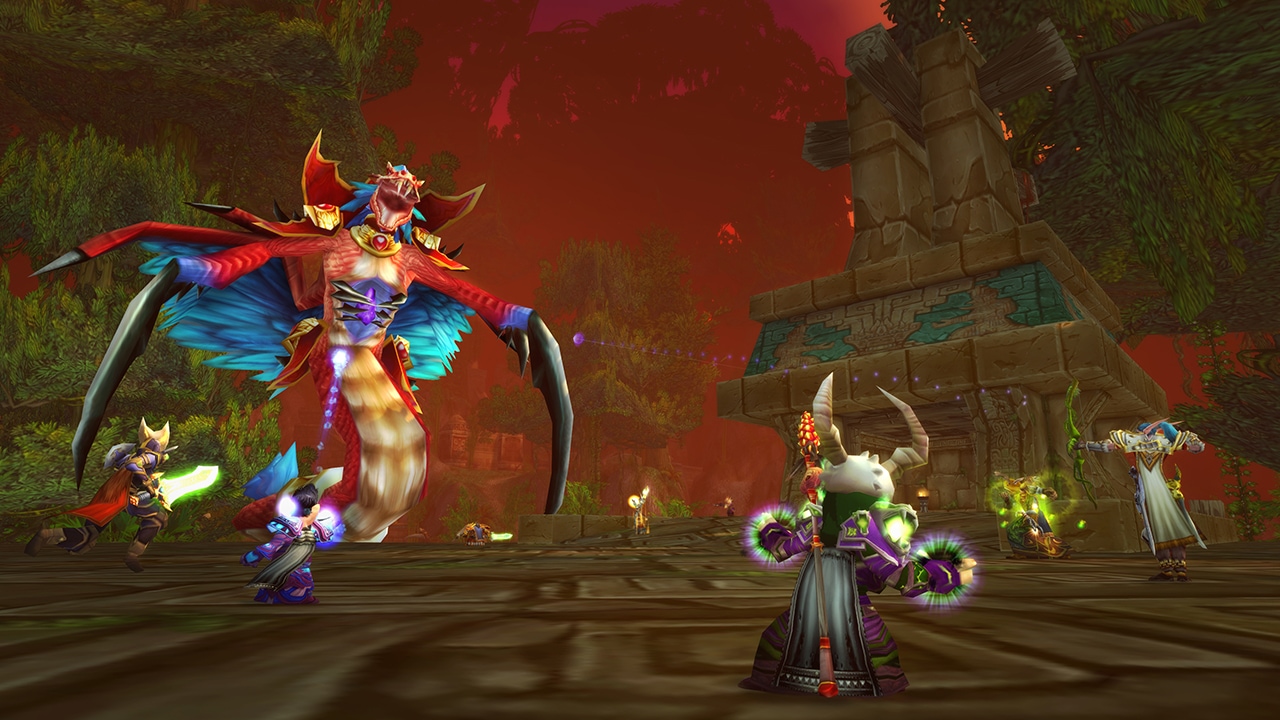
A timeline without the mythology
- September 2005: Corrupted Blood spreads beyond its intended encounter. The pet route is central to the incident’s documented history. [1]
- September 21, 2005: Contemporary reporting describes outbreaks in major cities and transmission through proximity. [2]
- 2007: Eric Lofgren and Nina Fefferman publish a paper discussing the potential of virtual worlds for epidemic research. [3–4]
We do not attach an exact death toll or a single server-wide duration to this account. Those claims need more evidence than the sources used here provide. The important connection is the movement of an effect across a boundary, not an inflated count of casualties.
Why a city changes the meaning of a mechanic
| Question | Raid encounter | Shared city |
|---|---|---|
| Why are players there? | To face a specific challenge | To trade, travel or meet others |
| Expected preparation | A coordinated group | Mixed purposes and readiness |
| Meaning of proximity | A combat decision | Part of ordinary social play |
Our analysis: The surprise is not simply that damage was high. The activity changed without everyone choosing it. A player using a social hub could become involved in somebody else’s raid mechanic. The table describes that change in expectations; it is not a reconstruction of damage values or a measured transmission model.
The player lesson: boundaries are part of the rules
In a raid, a dangerous status effect can be readable: the group knows where the encounter begins, what it is attempting and why it may fail. Moving that effect into an ordinary city removes much of the surrounding explanation. What feels like a challenge to one group can become unexplained disruption to another.
Persistent worlds make this especially interesting. Travel, companions and social spaces are valuable because they connect activities. Those connections also mean a rule cannot always be understood by looking at a single encounter in isolation. Designers have to consider what happens when a state survives a transition.
From a player’s perspective, this is why the incident makes a stronger story than a boss simply doing too much damage. It changed the apparent relationship between safe social space and dangerous combat space. The world felt connected in a way its intended encounter structure had not accounted for.
What the research does—and does not—show
Lofgren and Fefferman’s 2007 paper explored how virtual game worlds might help researchers study responses to epidemics. The accompanying research announcement emphasized the possibility of observing social behavior within a persistent game. [3–4]
That is a research opportunity, not proof that WoW accurately predicts a real pandemic. A game changes the costs of risk, the consequences of death and the options available to its participants. Any comparison needs to account for those differences. It would be misleading to turn an interesting analogy into a validated forecasting claim.
The takeaway
Corrupted Blood is memorable because a local rule acquired consequences beyond its original setting. For players, it is a story about an unexpectedly connected world. For design analysis, it is a reminder to test transitions between systems as carefully as the systems themselves.